Management of Medical Emergencies in the Dental Office:
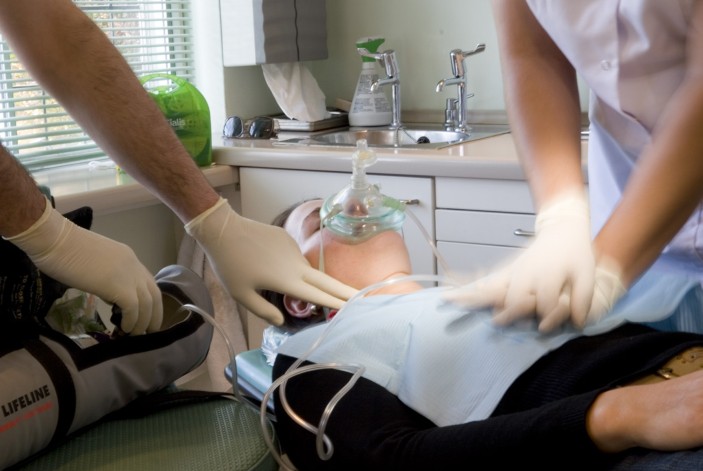
Dentists need to be equipped to handle any medical issues that may occur while they are working. Under the direction of the Japanese Dental Society, a study was carried out in Japan between 1980 and 1984 by the Committee for the Prevention of Systematic Complications During Dental Treatment.
The findings of this study revealed that, in any given year, anything between 19% and 44% of dentists saw a patient who had a medical emergency.
About 90% of these issues were minor, but only 8% were rated as significant. It was discovered that 35% of the individuals had a recognised underlying illness. 33% of those individuals had cardiovascular disease, according to the data.
I. ESSENTIAL EMERGENCY DRUGS
The medications that ought to be included in a dentist's emergency supply are listed below.4 There are six medications that every dentist should consider vital.
1. Oxygen
Except for hyperventilation, every emergency calls for oxygen. For the freely breathing patient, this should be done using a clear full face mask, and for the apneic patient, with a bag-valve-mask device.
Therefore, oxygen should be given whenever possible, with the exception of the patient who is hyperventilating. Even though a patient with chronic obstructive pulmonary disease may require low oxygen levels to breathe if they are chronic carbon dioxide retention, they should not be denied it for the management of a medical emergency.
If they need to be given oxygen for a brief while to get through the emergency, this shouldn't impair their desire to breathe.
2. Epinephrine
The medicine of choice for treating anaphylaxis and asthma in an emergency setting when salbutamol or albuterol are ineffective is epinephrine. dentist near me Although epinephrine is also recommended for the treatment of cardiac arrest, the likelihood that it will be administered in a dental office setting may be lower due to the lack of intravenous access.
In this latter emergency, where adequate oxygenation and prompt defibrillation are most crucial for the cardiac arrest dysrhythmias with the relatively best prognoses, namely ventricular fibrillation or pulseless ventricular tachycardia, its intramuscular administration is less likely to be very effective.
3. Nitroglycerin
This medication is recommended for myocardial infarction or acute angina. It is distinguished by a quick start to action. It is offered as sublingual pills or a sublingual spray for emergency situations. One crucial thing to be aware of is that after the bottle has been opened and the tablets have been exposed to air or light, their shelf life is only about three months.
4. Injectable Antihistamine
It is recommended to use an antihistamine to treat allergic responses. Life-threatening allergic reactions require parenteral medication, whereas moderate, non-life-threatening reactions can be treated orally.
Diphenhydramine and chlorpheniramine are two injectable drugs that might be taken into consideration. They can be used to treat less severe allergic responses, especially those with signs and symptoms that are largely dermatological, such urticaria, or as the only treatment for anaphylaxis. Diphenhydramine or chlorpheniramine at doses of 25 to 50 mg or 10 to 20 mg are suggested for adults.
5. Albuterol (Salbutamol)
For the treatment of bronchospasm, a selective beta-2 agonist like albuterol (salbutamol) is the primary option. It induces selective bronchodilation when inhaled and has negligible systemic cardiovascular effects. A peak effect occurs in 30 to 60 minutes, and the impact lasts for 4 to 6 hours. Adults should use two sprays, repeating as necessary. One spray for children, repeated as necessary.
6. Aspirin
One of the most recently recognised life-saving medications is aspirin (acetylsalicylic acid), which has been demonstrated to lower overall mortality from acute myocardial infarction.
To stop the progression from heart ischemia to damage to infarction, it is administered during an acute myocardial infarction. Aspirin can provide this advantage for a small amount of time early on during a myocardial infarction.
7. Oral Carbohydrate
It should be simple to access an oral carbohydrate supply, such as fruit juice or non-diet soft drinks. Although this isn't a medicine and possibly shouldn't be on the list, it should still be regarded as important.
It might not be understood that this sugar source is an essential piece of the emergency supplies if it is maintained in a refrigerator. Therefore, it should be thought about including this in the emergency kit. Its use is recommended for the treatment of hypoglycemia in patients who are conscious.
II. ADDITIONAL DRUGS
In addition to the six medications mentioned above, a number of other medications are recommended for inclusion in an emergency kit, as listed in Table 2.4.
1. Glucagon
This medication enables intramuscular therapy of hypoglycemia in a patient who is unconscious. In a diabetic emergency, 50% dextrose intravenously is the best treatment for severe hypoglycemia. If an intravenous line is not present and venipuncture is not anticipated to be performed, as is frequently the case at a dentist office, glucagon is required.
2. Atropine
This anti-muscarinic, anti-cholinergic medication is recommended for the treatment of bradycardic hypotension. The initial dose that is advised is 0.5 mg, with further increments as needed up to a maximum of 3 mg. Contrarily, doses of less than 0.4 mg have been linked to the production of a bradycardia, most likely as a result of the activities of atropine on the central nervous system.
3. Ephedrine
This medication, a vasopressor, can be used to treat severe hypotension. When compared to epinephrine, it has similar cardiovascular effects, but ephedrine is less strong and acts for a longer period of time—between 60 and 90 minutes.
When administering to a patient with ischemic heart disease, the same considerations mentioned with epinephrine administration should be taken into account. It should ideally be injected intravenously in 5 mg increments to treat severe hypotension. It should be administered intramuscularly in doses between 10 and 25 mg.
4. Corticosteroid
It may be necessary to administer a corticosteroid like hydrocortisone to prevent recurring anaphylaxis. A function for hydrocortisone in the treatment of an adrenal crisis is also possible. Their unusually sluggish onset of action, which even when given intravenously approaches an hour, is a noteworthy limitation to their usage in crises.
Due to their limited utility during the emergency's acute phase, these medications are not regarded as critical. One dose carries a modest risk of an adverse reaction. The model drug for this class is hydrocortisone, which can be used to treat these crises in doses as high as 100 mg.
5. Morphine
The therapy of significant pain associated with a myocardial infarction is suggested by the use of morphine.
The analgesic of preference for this use is morphine, according to recommendations for advanced cardiac life support.5 The dosage is titrated intravenously in one- to three-mg intervals until pain relief is achieved.
A drop in blood pressure and respiratory depression should serve as your guide in this. The elderly should be approached with the utmost caution. If an intravenous is not available, it is possible to inject morphine intramuscularly in a dose of about 5 mg. Again, older patients should be given lesser doses to consider.

Comments
Post a Comment